
March 2026 Scaffold Import Update: Separate Section 232 Steel From the New US Surcharge
For scaffold distributors, contractors, rental fleets, and project buyers importing into the United States: many steel scaffold lines remain under 50% Section 232 duty, the February 20, 2026 temporary surcharge should not be blanket-stacked on those lines, Australia-origin cargo is not carved out, and mixed-content kits now need line-by-line broker review.
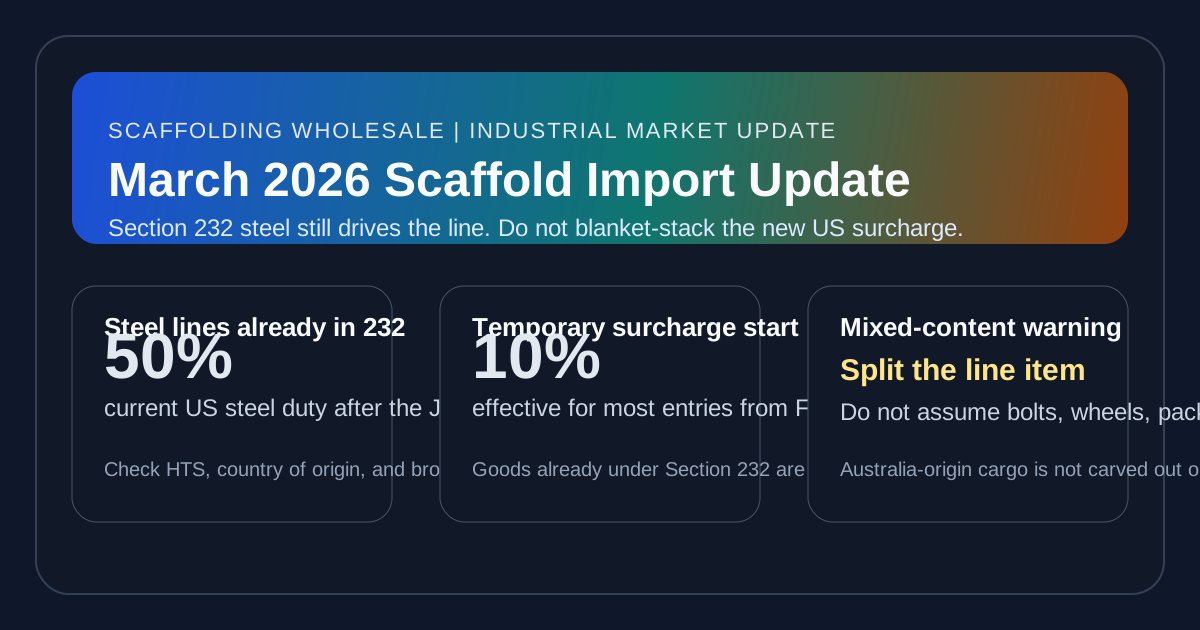
The strongest buyer signal this week is not a new scaffold safety rule. It is a customs and landed-cost reset: steel lines already inside Section 232 should stay anchored to the 50% steel rule, the new 10% US temporary surcharge should not be blanket-stacked on top of those lines, and mixed-content kits now need a clearer broker memo before the PO is released.
We reviewed US, Australian, customs, and steel-market sources inside the last 30 days. The actionable change for scaffold distributors, contractors, rental fleets, and project buyers is quote architecture and shipment evidence, not a brand-new field scaffold design rule.
What Changed
The timeline that now drives US-bound scaffold pricing
This topic is only important because several policy layers now sit on top of each other. The buyer mistake is to remember one date and forget the others.
| Date | Policy event | What it changes in practice |
|---|---|---|
| 2025-03-05 | Derivative steel implementation published | Federal Register implementation for the 2025 steel action lists HTS 7308.40.00 in the derivative steel table. Buyers using scaffold-related Chapter 73 lines should treat tariff classification as a live pricing variable, not a broker-side afterthought. |
| 2025-06-04 | Section 232 rate doubled to 50% | The White House states the steel and aluminum tariff rate rises from 25% to 50% and applies to imports from all countries. That reset remains the anchor cost for steel entries already inside Section 232. |
| 2026-02-20 | Reciprocal regime ends; temporary surcharge announced | Australia DFAT says the IEEPA reciprocal tariff framework terminated after the US Supreme Court decision on February 20, 2026. The White House replaced it with a temporary 10% import surcharge. |
| 2026-02-24 | Temporary surcharge begins | The White House sets the effective time at 12:01 a.m. EST on February 24, 2026. Goods already loaded and in transit before then can still use the transit exception if entered before March 27, 2026. |
| 2026-03-04 to 2026-03-13 | Fresh US steel market data lands | AISI reported January 2026 US mill shipments up 1.7% month over month. On March 13, 2026, AISI said February steel import permit applications rose 5.2% versus January, while finished permit tonnage fell 4.8% from January final imports. |
Why It Matters
Three planning rules changed for buyers, specifiers, and import coordinators
The direct consequence is not just a new landed-cost number. It is a new decision sequence for how you structure the quote, what you ask the broker, and which shipment evidence you preserve before filing.
Impact On Buyers
How to re-scope a scaffold PO before it turns into a customs problem
These are the most common scaffold import situations we see after the February 2026 reset. The point is not to memorize policy language. The point is to know which exact follow-up question changes the commercial outcome.
| Typical product situation | What changed | What to ask before quote release | Commercial move |
|---|---|---|---|
| Steel scaffold frames, props, braces, or other Chapter 73 entries already mapped to Section 232 | Keep the 50% Section 232 treatment as the first pricing rule. Do not automatically add the temporary 10% surcharge on top if the entry is already inside the White House exception. | Ask for the exact HTS line, origin country, and confirmation that the broker is treating the entry as already subject to Section 232. | Break freight, customs, and tariff assumptions out on the quote. Do not hide them inside one blended unit price. |
| Mixed-content derivative article with steel plus non-steel content | CBP guidance already requires the steel and non-steel values to be separated for derivative articles. That means mixed kits need a fresh broker memo after February 20, 2026 rather than a blanket exemption assumption. | Ask whether the non-steel portion needs separate temporary-surcharge treatment and whether the customs entry needs two value buckets. | Quote the steel content, non-steel content, and freight/admin contingencies on separate lines before the PO is approved. |
| Australia-origin steel scaffold shipment into the United States | DFAT says the 50% steel tariff now applies to all countries. The Australia origin story matters for supplier qualification and freight timing, but it does not remove the US steel duty by itself. | Ask for origin, country of melt and pour, and whether the supplier is mixing Australian-origin documentation with third-country steel content. | Treat Australia as a documentation and delivery variable, not as an automatic tariff carve-out. |
| Cargo loaded before February 24, 2026 but entered later | The White House allows a transit exception only if the goods were loaded onto a vessel and in final mode of transit before 12:01 a.m. EST on February 24, 2026 and entered before March 27, 2026. | Ask for bill of lading timing, load date, and entry date evidence before you assume the exception still works. | Attach transit proof to the internal shipment file before customs entry, not after the broker requests it. |
Evidence
Current market numbers say paperwork pressure is rising faster than availability pressure
AISI's early-March releases do not show a simple stop in US steel movement. They show a market where domestic shipments are still moving and import permit activity is still present, but the product mix and landed-cost logic are shifting.
| Signal | Latest figure | Direction | Why a scaffold buyer should care | Source |
|---|---|---|---|---|
| US steel mill shipments | 7,583,826 net tons in January 2026 | +1.7% vs December 2025 and +2.0% vs January 2025 | This looks like a pricing and paperwork reset more than an immediate US steel availability collapse. | AISI, January Steel Shipments Up 1.7 Percent From Prior Month, March 4, 2026 |
| Total steel import permit applications | 1,651,000 net tons in February 2026 | +5.2% vs January 2026 permit data and unchanged vs January final imports | Import activity did not freeze after the February tariff change. Buyers still need to assume entries will move, but at a different landed-cost structure. | AISI, AISI Releases February SIMA Imports Data, March 13, 2026 |
| Finished steel import permit tonnage | 1,189,000 net tons in February 2026 | -4.8% vs January 2026 final imports | The finished side softened even while total permits rose, which supports tighter quote review for fabricated or finished scaffold SKUs. | AISI, AISI Releases February SIMA Imports Data, March 13, 2026 |
| Structural pipe and tubing permit change | Up 41% in February permits vs January final imports | Large month-over-month increase in a category close to scaffold raw material planning | It is an early warning that pipe-and-tube procurement conditions are moving, even if finished scaffold demand signals are mixed. | AISI, AISI Releases February SIMA Imports Data, March 13, 2026 |
Method And Boundary
This week's change is customs-side, not a fresh field-rule rewrite
We also checked the scaffold-rule side because buyers often overreact to tariff news by rewriting the entire compliance pack. That is usually the wrong move.
Risks And Constraints
Where this can still go wrong
The highest-risk mistakes are administrative, not conceptual. They usually happen when one team assumes another team has already validated the entry treatment.
| Risk | Impact | Why it matters | Mitigation |
|---|---|---|---|
| Finance team adds 10% to every US-bound scaffold line | High | That can overquote steel lines already excepted from the temporary surcharge because they are inside Section 232. | Send a broker-approved duty memo by HTS line before releasing the customer quotation. |
| Procurement team treats a mixed-content kit as one tariff bucket | High | CBP guidance separates steel and non-steel content on derivative articles. A blended assumption creates customs and margin risk. | Separate BOM value by steel content, non-steel content, and freight/admin cost before PO confirmation. |
| Australia origin is treated as a tariff exemption instead of a source descriptor | High | DFAT says the current 50% steel tariff applies to all countries. Origin still matters for documentation and sourcing strategy, but not as a blanket duty escape. | Keep origin, melt-and-pour, and HTS confirmation together in the shipment file. |
| Transit exception is assumed without proof | Medium | The White House transit exception has a strict load-date and entry-date window. | Archive the bill of lading, vessel date, and entry date in the internal customs folder before filing. |
Action Checklist
What each buyer type should do next
If the page is useful, it should shorten the next internal meeting. These are the moves that usually turn the policy change into a cleaner quote and a safer shipment file.
Fast internal handoff
If you are sending this issue from sales to purchasing or from purchasing to the broker, the handoff sentence is simple: "Please confirm whether this HTS line is already inside Section 232, whether any non-steel value needs separate treatment after February 20, 2026, and whether our shipment file has transit proof if we are using the February 24 exception."
FAQ
Decision questions buyers still ask after the first read
These answers stay practical on purpose. The goal is to close the next commercial question, not to restate tariff theory.
Sources
Primary documents and current market references used for this page
Every time-sensitive conclusion above maps back to an identifiable source and date. Where the evidence supports a decision boundary rather than a hard universal rule, we say so explicitly.
| Source | Institution | Date | What it supports |
|---|---|---|---|
| Imposing a Temporary Import Surcharge to Address Fundamental International Payments Problems | The White House | 2026-02-20 | 10% surcharge start date, transit exception window, and exception for goods already under Section 232 and other listed measures. |
| Adjusting Imports of Aluminum and Steel into the United States | The White House | 2025-06-03 | Section 232 steel and aluminum rate increase from 25% to 50% and all-country application. |
| Federal Register, March 5, 2025 implementation notice for derivative steel duties | U.S. Government Publishing Office | 2025-03-05 | HTS 7308.40.00 appearing in the derivative steel table used for scaffold-related tariff planning. |
| Latest on US tariffs | Australian Government Department of Foreign Affairs and Trade | 2026-03-18 | Australia-facing explanation that the 50% steel tariff applies to all countries and that the old reciprocal tariff regime ended on February 20, 2026. |
| International Emergency Economic Powers Act (IEEPA) Frequently Asked Questions | U.S. Customs and Border Protection | 2026-02-25 | CBP guidance that Section 232 goods were excepted from reciprocal tariffs and that non-steel content of derivative articles can require separate treatment. |
| U.S. Tariff Overview January 2026 | U.S. Customs and Border Protection | 2026-01 | CBP summary that products with mixed steel, aluminum, or copper content can still face the applicable Section 232 treatment by content. |
| AISI Releases February SIMA Imports Data | American Iron and Steel Institute | 2026-03-13 | February 2026 permit trends, finished import market share estimate, and structural pipe and tubing permit shift. |
| January Steel Shipments Up 1.7 Percent From Prior Month | American Iron and Steel Institute | 2026-03-04 | Current US domestic shipment baseline used to frame availability versus pricing risk. |
| 2025 Joint Report of the Office of the United States Trade Representative and the United States Department of Commerce | USTR and U.S. Department of Commerce | 2025-01-30 | What SIMA, GSTM, and AIM monitors are designed to show and why country-of-melt-pour and cast-smelt data matter for buyers. |