
Scaffolding Planks & Decking: Steel vs Aluminum vs LVL Timber Procurement Guide
Compare steel, aluminum, and LVL scaffolding planks for global procurement. Check load classes, OSHA/EN limits, lifespan, QA steps, and request quotes.
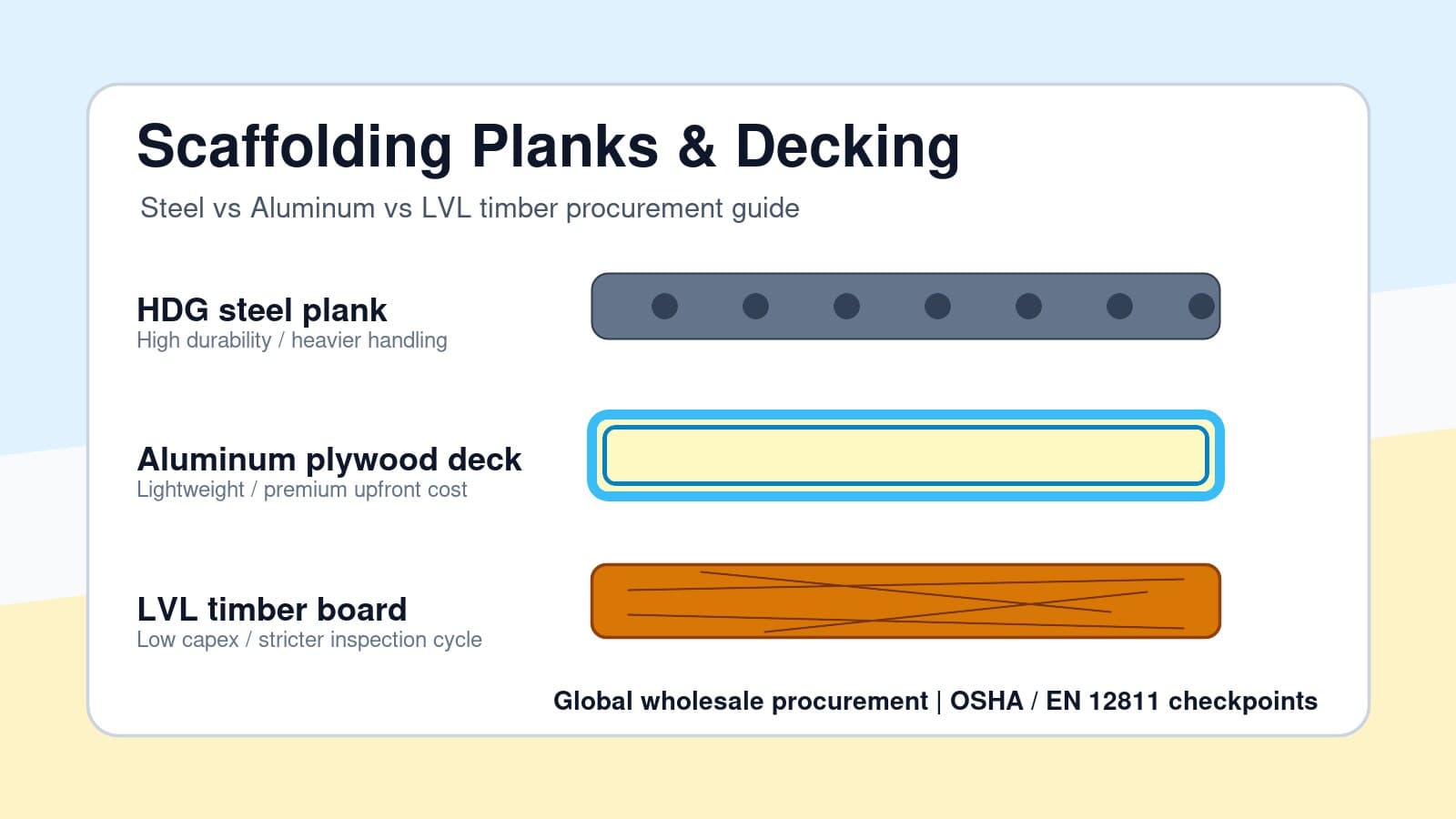
Planks take the most abuse of any scaffolding component. Procurement teams face a constant battle balancing the low upfront cost of LVL timber against the extreme durability of hot-dip galvanized steel or lightweight aluminum.
Selecting the wrong decking material doesn’t just blow out your replacement budget—it introduces critical fall and tripping hazards. This guide breaks down the engineering performance, load class compliance (EN 12811), OSHA requirements, and total cost of ownership (TCO) for Steel, Aluminum, and Laminated Veneer Lumber (LVL) scaffolding boards. We arm you with the precise checklists needed to verify supplier quality and avoid catastrophic failures on-site.
Scope and Limits for This Procurement Guide
The Materials
Executive Summary: The Big Three
Understanding the core characteristics of the most common scaffolding decking options used globally.
The transition from traditional solid sawn wood planks to engineered LVL, and ultimately to steel and aluminum decks, reflects the industry's shift toward stricter safety regulations and better lifecycle ROI. While solid wood is still used in some developing markets, professional fleets in North America, Europe, and Australasia now demand engineered solutions that offer predictable deflection limits and reliable load-bearing capacities.
Deflection & Performance
Engineering the Deck: Load Classes Explained
Why material stiffness matters for worker safety and standard compliance.
Deflection Under Load (Exaggerated for clarity)
As spans increase (e.g., 3.0m bays), materials with lower stiffness experience higher deflection. Excessive deflection creates a trampoline effect, leading to worker instability and potential failure.
Scaffolding standards like EN 12811-1 categorize working platforms into "Load Classes" ranging from Class 1 (light maintenance, 0.75 kN/m²) to Class 6 (heavy masonry, 6.00 kN/m²). Similarly, OSHA defines platforms as Light Duty (25 psf), Medium Duty (50 psf), and Heavy Duty (75 psf).
When a worker carrying heavy tools stands in the middle of a 3.0m (10ft) plank, the board bows downward (deflection). OSHA dictates that a plank must not deflect more than 1/60th of its span. For a 10-foot span, that is a maximum deflection of 2 inches. Steel and aluminum easily meet these criteria even at extended spans, whereas timber and LVL boards must be significantly thicker (often 38mm or 42mm) to safely bridge wide bays without excessive "bounciness."
Technical Data
Direct Comparison: Steel vs Aluminum vs LVL
A side-by-side technical evaluation for procurement decision-making.
| Specification | LVL Timber Board | HDG Steel Plank | Aluminum/Plywood Deck |
|---|---|---|---|
| Primary Use Case | Tube & Fitting, Bricklaying | Heavy Civil, System Scaffolding | Facade, High-Rise, Fast Erection |
| Initial Capital Cost | Low ($) | Medium ($$) | High ($$$) |
| Expected Lifespan | 1 to 3 Years | 10+ Years (if HDG) | 15+ Years (Plywood requires replacement) |
| Weight per Meter | Medium (Absorbs water, gets heavier) | Heavy (Labor intensive) | Very Light (Reduces labor fatigue) |
| Fire Resistance | Poor (Flammable) | Excellent (Non-combustible) | Good (Aluminum frame won't burn) |
| Slip Resistance Profile | Natural wood friction, drops when wet | Perforated holes / dimpled surface | Textured phenol film on plywood |
| End Connections | Plain ends or metal end bands | Welded hooks (O-type or U-type) | Extruded aluminum hooks with wind locks |
Quality Gate
Procurement QA Checklist
What your inspection team must verify before the container leaves the factory.
Pre-Shipment Inspection (PSI) Action Checklist
- For Steel Planks - Galvanization Thickness: The most common factory shortcut is thin electro-galvanizing instead of Hot-Dip Galvanizing. Use a magnetic thickness gauge. Ensure the zinc coating is at least 60-70µm to prevent premature rusting inside the perforated holes.
- For Steel Planks - Hook Welding: Planks fail where the hooks attach to the main body. Ensure the hooks are fully welded (not spot welded). For U-ledger systems, check that the hook geometry precisely matches your ledger diameter (usually 48.3mm or customized U-profiles) to prevent rocking.
- For Aluminum Decks - Plywood Sealant: Check the edges where the marine plywood meets the aluminum extrusion. It must be sealed with a high-quality waterproof sealant, otherwise, capillary action will draw water into the plywood, causing rapid rot and delamination.
- For LVL Timber - Grain and Grading: Ensure the factory provides scaffold-grade structural certification, such as BS 2482 compliance where that standard is specified. OSHA sets performance rules rather than approving a specific board; verify grading marks, span tables, no severe edge knots, and metal end banding or plates to prevent splitting when dropped.
- Wind Lock Mechanisms: For engineered decks, verify that the anti-lift wind locks engage smoothly and do not require excessive force, which could slow down dismantling times.
Help & Support
Frequently Asked Questions (Buyer Q&A)
Answers to the most common queries we receive from scaffolding importers.
Verification
References and Sources
Verified international standards regarding structural decking specifications.
- OSHA 29 CFR 1926.451 - General Requirements for Scaffolds
Defines the specific capacity and deflection limits (1/60th of the span) for scaffolding platforms in the United States.
- British Standards Institution (BSI): BS EN 12811-1:2003
Specifies performance requirements and methods of structural and general design for access and working scaffolds, including Load Classes 1 through 6.
- Scaffold & Access Industry Association (SAIA)
Provides industry best practices and guidelines for the safe erection and dismantling of various scaffolding systems, including plank selection.
Upgrade Your Scaffolding Decks
Stop replacing rotten wood planks every two years. Contact our manufacturing desk today to get a direct quote on Hot-Dip Galvanized Steel Planks and lightweight Aluminum Decks engineered to meet EN and OSHA standards.