
Scaffold Caster Wheels: EN 1004-1 & OSHA 1926.452(w) Total-Lock Brakes, Polyurethane vs Rubber, Stem Retention & B2B Importer Procurement Guide
Compare scaffold caster wheels, PU vs rubber, brake and stem checks, EN 1004-1 scope and OSHA requirements. Use the checklist to request a supplier quote.
Scaffold Caster Wheels: A Buying Decision Before a Price Comparison
Choose scaffold caster wheels by approved tower fit, brake behavior, retention and documented load conditions before comparing tread or unit price. Polyurethane is a useful candidate for wear and floor protection; elastic rubber deserves comparison where vibration and noise matter. Neither material establishes a safe tower configuration by itself.
This guide helps wholesale importers, hire-fleet buyers and contractor purchasing teams turn incomplete catalog claims into an RFQ and receiving plan. Start with the approved tower model and destination, then compare complete caster assemblies. Keep the selected wheel, fork, brake, bearing, spindle, nut and retaining parts under one controlled specification so a cheaper substitute cannot silently change the agreed configuration.
For system context, read the mobile scaffold tower procurement guide and the scaffold base jack comparison. Review the scaffolding product range before sending a configuration-specific inquiry.
Request a caster specification and evidence review
Figure 1: Original explanatory schematic, not to scale. The illustrated locking and retention concepts do not certify a design or establish dimensions, tread properties, load ratings or test results.
Total-Lock Brakes: Check the Function and the Approved Configuration
A wheel brake restrains rolling; a swivel lock restrains fork rotation around the stem axis. Total-lock commonly describes a mechanism that restrains both. A pedal label, colour or audible click cannot prove that both actions work under the conditions declared by the manufacturer. Ask the supplier to identify the mechanism on the drawing and explain how engagement, wear and release are checked.
The OSHA mobile scaffold rule is a use requirement; the BSI EN 1004-1 record describes a tower product standard. Its published scope covers towers up to 12 m indoors and 8 m outdoors, rather than all rolling modular scaffolds. PASMA also distinguishes configurations outside that scope. Do not present an unverified clause number, proof-load multiple or inclined-plane angle as a universal acceptance threshold. Obtain the applicable test procedure and acceptance criteria before ordering.
Polyurethane vs Rubber vs Phenolic: Tread Selection & Core Integrity
The choice of wheel tread construction influences load-bearing capacity, rolling resistance, impact absorption, floor protection, and resistance to aggressive jobsite chemicals. Below is an engineering screening framework for the tread options being compared. These profiles do not establish material-specific load limits.
Comprehensive Tread Material Engineering Comparison Matrix
| Tread & Hub Material | Hardness Evidence | Working Rating Evidence | Static / Test Evidence | Floor Marking & Slab Impact | Chemical & Environmental Resilience | Fleet Cost Questions |
|---|---|---|---|---|---|---|
| Cast polyurethane on iron | Supplier compound and tolerance | Complete assembly rating required | Separate declared value and method | Sample on specified floor | Check water, chemicals and temperature | Compare bond failures and replacement availability |
| Thermoplastic polyurethane | Supplier compound and tolerance | Do not transfer another PU rating | Separate declared value and method | Verify marking and indentation | Check actual formulation limits | Compare wear and availability at matched duty |
| Elastic rubber on metal | Supplier compound and tolerance | Verify exact wheel and fork model | Check sustained-load behavior | Check marking and noise | Review oil and cleaner exposure | Include storage deformation in fleet trial |
| Phenolic resin | Model-specific material data | System approval required | Separate declared value and method | Assess hard-contact damage | Require application-specific temperature limits | Include floor repair and handling costs |
| Cast iron or steel | Material identity required | System approval required | Separate declared value and method | Assess concentrated contact loads | Check corrosion and complete assembly limits | Confirm suitability before price comparison |
| Nylon / polyamide | Grade and conditioning required | System approval required | Separate declared value and method | Check noise and substrate damage | Review moisture and cleaner exposure | Evaluate cleaning duty and bearing service |
Polyurethane Bond Integrity: What to Ask the Supplier
For a bonded tread, ask how the hub surface, adhesive system and curing process are controlled. Mechanical keying is one possible design feature; it is not a universal specification or a guarantee against separation. Different compounds need different process windows, so a prescribed temperature without the supplier’s process qualification can create a misleading acceptance criterion.
Request test identification, sample traceability and acceptance limits for the actual construction. Agree whether validation includes aging, relevant chemical exposure or load cycling, and who owns a bond-failure claim after shipment. A sample photograph cannot establish adhesion strength. The Blickle material guide illustrates why compound-specific properties matter; it does not validate another supplier’s wheel.
Caster Spindle Interfaces and OSHA Stem Retention
OSHA 1926.452(w)(9) requires caster and wheel stems to be pinned or otherwise secured in scaffold legs or adjustment screws. Specify the matched retention detail rather than assuming every system uses the same hole and pin. A pin must engage as designed and remain retained during the permitted handling and service conditions.
Tube outside diameter alone does not establish a stem fit. As an illustrative geometry check, a 48.3 mm tube with 3.2 mm wall has a nominal 41.9 mm bore. A 35.0 mm stem would leave 6.9 mm diametral, or 3.45 mm radial, clearance before tolerances and coatings. That arithmetic cannot establish an acceptable fit: obtain the approved sleeve, bore, insertion, shoulder, retention and tolerance drawing. Do not drill or modify a scaffold leg merely to accommodate an unmatched caster.
Scaffold Caster Stem Interface Specifications & Retention Standards
| Spindle Interface Type | Critical Dimensions & Pitch | Collar / Jack Nut Construction | Functional Application | Mechanical Retention Feature | Acceptance Evidence |
|---|---|---|---|---|---|
| Adjustable threaded spindle | Thread form, diameter, pitch and engagement | Matched nut and shoulder drawing | Leveling within tower manual limits | Approved retention through leg or adjuster | Written compatibility and maximum extension |
| Round pinned stem | Bore, stem OD, insertion and hole position | Shoulder contact and seating detail | Fixed-height approved tower leg | Specified pin with its own retaining device | Matched drawing and first-article fit check |
| Expanding stem | Tube bore, sleeve travel and tightening method | Supplier-defined bearing surface | Only where system manufacturer permits it | Documented securing method; assess contamination | Do not accept friction fit by appearance alone |
| Square stem with snap pin | Section size, hole position and engagement | Matched frame end and shoulder | Proprietary utility scaffold frames | Check full pin engagement and service condition | Use only for the identified frame model |
| Modular-system adapter | Approved adapter and leg identifiers | Manufacturer-designed load path | System-specific mobile configuration | Retaining parts shown on assembly drawing | No assumed Ringlock interchangeability |
| Bolt-on plate adapter | Bolt pattern, fasteners and mating plate | Approved plate and support detail | Proprietary engineered mobile equipment | Specified fastener locking and inspection | Requires design approval for that assembly |
Match the Supplied Model, Not Just the Product Photograph
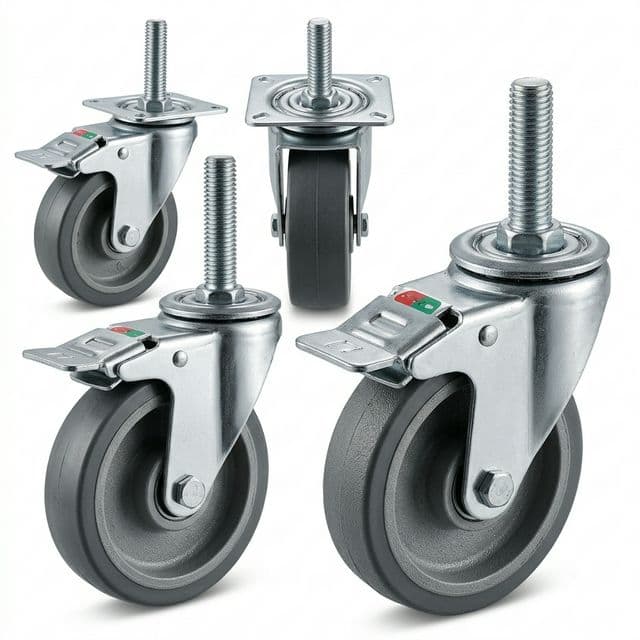
The reference image shows black wheels, metal forks, brake pedals and threaded mounting stems. Appearance cannot establish the tread compound, nominal diameter, internal bearing design, steel grade, working load or approval status. Ask for a model identifier and dimensioned drawing tied to the quotation and reports.
Approve a first article against the actual tower interface and preserve its identification. If production changes the wheel, fork, brake, stem or bearing, require a documented review rather than accepting a visually similar substitute.
Send a tower drawing for a caster compatibility inquiry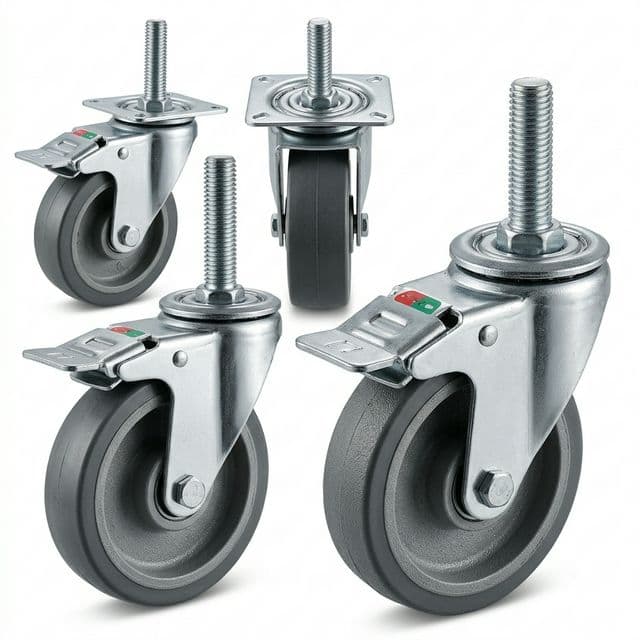
Bearings and Seals: Specify a Maintainable Assembly
Ask separately about the wheel bearing and swivel bearing. Concrete dust, slurry and cleaning water create different maintenance demands from a clean warehouse floor. Obtain the manufacturer’s sealing and lubrication instructions, allowable play and replacement criteria. Double raceways, a particular steel grade or a grease nipple are construction details; none independently proves durability in your duty.
For serviceable designs, ask which lubricant, application method and interval are permitted. For sealed designs, record the replacement procedure rather than instructing yard staff to force in grease. Include pedal damage, tread separation, binding, excessive play and missing retention parts in the fleet inspection record. Isolate a suspect assembly instead of mixing unmatched replacement parts.
Wheel Diameter, Rolling Clearance & Load Capacity Matrix
Wheel diameter affects obstacle interaction, but pushing effort also depends on tread, bearings, loading and the route. Do not apply a fixed percentage improvement to every 6-inch versus 8-inch comparison. Inch classes and nominal metric labels must be checked against the actual drawing; changing overall height or swivel offset can also change the tower geometry. The matrix below records information to obtain, rather than unsupported catalogue capacities.
| Caster Model / Profile | Wheel Size (Dia. × Width) | Overall Height (Excl. Stem) | Swivel Lead / Offset | Dynamic WLL (Rolling) | Static / Test Evidence | Primary Industry Use-Case | Unit Mass (Kg) |
|---|---|---|---|---|---|---|---|
| 6-inch / nominal 150 mm class | Confirm actual diameter and tread width | Obtain drawing | Confirm swivel envelope | Request rated rolling conditions | Request separate test evidence | Check route and base-height constraints | Obtain packed and net mass |
| 8-inch / nominal 200 mm class | Confirm actual diameter and tread width | Obtain drawing | Confirm pedal clearance | Request rated rolling conditions | Request separate test evidence | Common RFQ option; not automatic fit | Obtain packed and net mass |
| 10-inch / nominal 250 mm class | Confirm actual diameter and tread width | Check changed tower geometry | Confirm swivel envelope | Request rated rolling conditions | Request separate test evidence | Larger diameter does not approve rough ground | Obtain packed and net mass |
| Adjustable screw-jack version | Identify wheel independently of spindle | State minimum and maximum extension | Check brake access at all settings | Rate complete jack/caster assembly | Identify tested extension and model | Leveling only within approved configuration | Include nut, pin and protective packaging |
| Twin-wheel assembly | Identify both wheels and axle layout | Obtain system-approved drawing | Check wheel interaction and clearance | Do not double a single-wheel rating | Require assembly-specific evidence | Only for an approved tower variant | Include full assembly and packing |
| Corrosion-resistant version | Identify tread, fork and fastener grades | Match original interface | Confirm brake and bearing details | Obtain model-specific declaration | Specify corrosion test and acceptance | Wash-down or marine duty needs full review | Include packaging and preservation |
B2B Receiving and Pre-Shipment Inspection Checklist
Agree the inspection plan before placing the order. Define the lot, sample selection, measurements, document checks and rejection rules. Separate first-article fit, type-test evidence and routine production inspection: they answer different questions. Any destructive or load testing needs a competent facility and an agreed procedure; a receiving checklist is not an instruction to improvise a test on an occupied tower.
These boxes start unchecked because no inspection has been performed by this article. Keep the completed receiving record with your order documents; the on-page checklist does not save inspection results.
Container Packing and Landed Cost: Check Weight and Floor Positions
Heavy casters can become weight-limited before a container is full, but a payload division alone cannot produce a shipment quantity. Ask for the pallet footprint, packed height, gross mass, permitted stacking and center-of-gravity information. Confirm the booked container limits, route restrictions and receiver’s handling equipment with the forwarder. A general container label does not establish one universal road payload.
Illustrative pallet arithmetic
Assume a quoted net caster mass of 7.5 kg, 144 units per pallet and 40 kg of pallet and packaging. Net product mass is 144 × 7.5 = 1,080 kg; gross pallet mass is 1,080 + 40 = 1,120 kg. If an approved floor plan allocates six such pallet positions, that portion of the shipment contains 864 casters and weighs 6,720 kg gross. These are declared example inputs, not measured product data or a proposed 20GP/40HQ loading plan.
The usable quantity is constrained by the floor layout, stackability, payload, load distribution and handling limits together. Recalculate after the supplier confirms actual dimensions and gross mass. Do not stack frames over caster pallets unless the packaging and securing design explicitly supports it. Mixed loads need approved blocking, lashing and unloading access rather than an assumed freight-saving percentage.
Compare cost per accepted assembly
Compare quotations using the same wheel construction, brake functions, retention kit, quantity, packaging, delivery term and named place. Separate product price, inland freight, inspection, international freight, insurance, destination charges and applicable import taxes. Record the currency and quotation validity date; do not import a tax rate from another market. Include spare parts and warranty handling when comparing fleet supply options.
For an arithmetic example, assume 1,000 assemblies at USD 24 each, USD 2,000 freight and USD 500 inspection, with taxes and destination charges excluded. That subtotal is USD 26,500. If 20 assemblies remain rejected and unreplaced, dividing by 980 accepted units gives USD 27.04 per accepted unit, rounded to cents. This is not a supplier quotation or a predicted defect rate. Its purpose is to show why a low invoice price cannot replace documented acceptance and a clear remedy for rejected goods.
Before payment release, request one evidence pack containing the final drawing, approved sample reference, declared ratings, relevant reports, inspection record and packing list. Assign an owner and a due date to every missing item. Hold a configuration mismatch for review even if the remaining paperwork is complete; document volume is not proof of technical compatibility.
Frequently Asked Questions: Scaffold Caster Engineering & Procurement
What is the difference between wheel-only and total-lock scaffold caster brakes?
A wheel-only brake restrains rolling; a total-lock design also restrains swivel rotation. Check the actual mechanism and the approved tower instructions. OSHA 1926.452(w)(2) allows positive wheel and/or wheel-and-swivel locks, or equivalent means, to prevent stationary movement. A trade name alone does not establish suitability or EN 1004-1 conformity.
Must a scaffold caster stem use a pin?
OSHA 1926.452(w)(9) requires stems to be pinned or otherwise secured in the leg or adjustment screw. Obtain the system manufacturer’s retention detail. A loose drop-in fit is not evidence of securing, while a drilled hole without the matched pin and retainer is an incomplete assembly.
Should I buy 6-inch or 8-inch scaffold casters?
Compare the tower-approved options against route obstacles, floor condition, base height, swivel clearance and rated duty. Inch labels and nominal metric sizes are not exact conversions. Do not select diameter by an unsupported percentage reduction in push effort, or calculate platform capacity by multiplying four wheel ratings.
How should buyers assess polyurethane tread delamination risk?
Ask for the compound, hub preparation and bond-validation method for the supplied model. Review sample identity and acceptance criteria, then inspect first articles for cracks or separation. A universal curing temperature or mandatory dovetail shape cannot replace construction-specific evidence. Agree warranty responsibility and replacement-wheel availability before ordering.
Does EN 1004-1 require a universal 3× load or 15-degree brake test?
This guide does not establish either threshold. The linked public BSI record establishes the standard’s scope, rather than a complete caster test procedure. Require the applicable edition, clause, load, duration, surface, acceptance criteria and matching model identification in the test report. Test loads must not be treated as working ratings.
What bearing information should a scaffold caster RFQ include?
Request wheel and swivel bearing types, sealing, maintenance instructions and permissible cleaning methods. Confirm whether the design is sealed for life or serviceable. A grease nipple is not proof of water resistance, and adding grease to an incompatible sealed assembly can cause damage. Inspect for excessive play and binding against the maker’s limits.
How many scaffold casters fit in a 20GP or 40HQ container?
There is no reliable universal count. Obtain carton and pallet dimensions, gross mass, stackability and handling limits. Check a floor-position plan alongside the booked container payload, road limits and unloading equipment. Mixed cargo can improve utilization only when blocking, load distribution and stacking are approved; the worked example below is arithmetic, not a packing guarantee.
Can screw-jack casters make a sloping ramp safe for tower use?
Do not use jack travel as permission to work on a ramp. The tower must remain level and within the manufacturer’s ground, extension and stability limits. OSHA 1926.452(w)(8) addresses leveling means; it does not grant a general operating slope. Ask the tower supplier to assess the proposed location and configuration before procurement.
Sources, Codes & Referenced Engineering Standards
Sources checked on 9 November 2026. The public records below support the stated scope and general distinctions. No first-hand physical test results, customer outcomes or product certifications are claimed:
- OSHA:29 CFR 1926.452(w): Mobile scaffolds
US construction: stationary locking, leveling and stem securing; not a product approval certificate.
- British Standards Institution:BS EN 1004-1:2020: Official scope and publication record
Scope and edition identification. Public catalogue text does not establish detailed caster test thresholds.
- PASMA:Product Standards: EN 1004-1, EN 1004-2 and BS 1139-6
Industry guidance distinguishing standard mobile towers, instruction manuals and configurations outside the standard scope.
- Blickle:Material description for wheel treads
Manufacturer material guidance; not evidence that the caster pictured here uses a particular compound or is approved for a tower.
Request Scaffold Caster Specifications and Supporting Reports
Send the tower model, interface drawing, destination market, ground conditions and order quantity for a configuration-specific quotation. Ask the supplier to identify the proposed caster and provide the matching drawings, declared working conditions, retention details and relevant test evidence before you approve an order.
Recommended Inquiry Parameters for Immediate Factory Quoting:
- ✓Wheel Size & Tread: 8-inch or 6-inch nominal class, with actual diameter, width and compound confirmed
- ✓Braking Action: Required wheel and swivel restraint functions, matched to tower instructions
- ✓Stem Specification: Adjustable screw jack (length & diameter) or solid round spindle with drilled toggle pin hole
- ✓Scaffold Tube Fit: Actual internal bore, approved tower model, drawing revision and retention detail
- ✓Target Order Scope: Number of pallets, 20GP/40HQ container lots, or mixed loading with aluminum scaffold towers