Published April 28, 2026 · Updated April 28, 2026 (stage1b research enhance)
Use the tool first to classify your loading bay gate setup into ready, review, or boundary lane. Then use the report layer to verify why the result is credible, where the limits are, and how to move to an RFQ without route duplication.
Input your bay geometry and control assumptions. This tool returns a practical release lane with explicit limitations so teams can move from keyword intent to RFQ action on the same canonical URL.
Canonical demand signal
20/mo
US broad-match volume for “loading bay gates” (2026-03-24 export).
Alias cluster size
6 aliases
Alias rows currently modeled in the canonical routing checklist.
Top-rail reference zone
965-1143 mm
OSHA top-rail alignment band (38-45 in).
Duty class anchors
0.75 / 2.00 / 3.00
kN/m2 public class references from HSE guidance.
Inspection baseline
Shift + 7-day
Before-shift (OSHA) plus UK legal interval/record controls.
US fatal falls signal
844 (2024)
BLS CFOI 2024: falls/slips/trips fatalities across all industries.
GB falls-from-height signal
35 (2024/25)
HSE fatal injuries overview for workers in Great Britain.
Good fit
Not a fit
No separate route is published for this alias intent. Use /learn/loading-bay-gates with the same tool and evidence workflow. This preserves one canonical decision path and prevents near-duplicate content drift.
Single URL for do + know intent
The same page executes tool checks first and then explains evidence, limits, and tradeoffs for decision quality.
Alias handled explicitly
“adjustable loading bay gates” is served on /learn/loading-bay-gates with dedicated anchor coverage instead of a duplicate route.
Result state is actionable
Every lane (ready/review/boundary) includes concrete next actions and a prefilled inquiry path.
Boundary controls are not hidden
Top-rail and opening checks now include US/UK boundary differences, 4:1 restraint trigger, and wind-control stop conditions.
Evidence and uncertainty are adjacent
Regulatory triggers, source dates, and “no reliable public dataset currently available” limits are shown in one reading flow.
| Step | Decision role | Output | Boundary trigger |
|---|---|---|---|
| 1. Normalize query into one canonical URL | Maps adjustable and scaffold-modified phrases to one route to prevent duplicate procurement pages. | Canonical decision surface: /learn/loading-bay-gates | If a team asks for a dedicated alias URL, stop and retain alias_merge policy. |
| 2. Run the loading-bay gate fit tool | Checks width class, duty lane, edge-protection geometry, wind condition, and inspection discipline together. | Ready / Review / Boundary status with explanation and next action | Any out-of-range top rail, missing toe board, ad-hoc inspection path, or unverified restraint/wind controls. |
| 3. Attach evidence and limits near the output | Pairs each result with regulation thresholds, assumptions, and unknowns. | Method + evidence + known/unknown ledger | Project specifics beyond public standard scope require supplier engineering pack. |
| 4. Convert result into RFQ action | Turns recommendation into a practical inquiry package instead of static content. | Prefilled inquiry CTA and minimum data checklist | Boundary result blocks direct release and forces technical review lane. |
| Keyword | Intent | US volume | CPC (USD) | Source file |
|---|---|---|---|---|
| loading bay gates | Commercial + decision research | 20 | 5.06 | data/keywords/bay-gates_broad-match_us_2026-03-24.csv |
| loading bay gates for scaffolding | Commercial qualification | 10 | 0.00 | data/keywords/bay-gates_broad-match_us_2026-03-24.csv |
| adjustable loading bay gates | Alias_merge (same page intent) | 0 | 0.00 | data/keywords/bay-gates_broad-match_us_2026-03-24.csv |
| scaffold loading bay gates | Alias_merge (same procurement intent) | 30 | 0.00 | data/keywords/bay-gates_broad-match_us_2026-03-24.csv |
| Alias keyword | Canonical keyword | Canonical route | Required updates |
|---|---|---|---|
| adjustable loading bay gates | loading bay gates | /learn/loading-bay-gates | title/meta variant + FAQ answer + H2 mention + internal anchor + no new route |
| bay gate | loading bay gates | /learn/loading-bay-gates | title/meta variant + FAQ answer + H2 mention + internal anchor + no new route |
| loading bay gate | loading bay gates | /learn/loading-bay-gates | title/meta variant + FAQ answer + H2 mention + internal anchor + no new route |
| scaffold loading bay gates | loading bay gates | /learn/loading-bay-gates | title/meta variant + FAQ answer + H2 mention + internal anchor + no new route |
| up and over loading bay gates | loading bay gates | /learn/loading-bay-gates | title/meta variant + FAQ answer + H2 mention + internal anchor + no new route |
| loading bay gates scaffolding | loading bay gates | /learn/loading-bay-gates | title/meta variant + FAQ answer + H2 mention + internal anchor + no new route |
| Trigger | Threshold | Procurement implication | Limit / counterexample | Source |
|---|---|---|---|---|
| Scaffold structural capacity floor | Scaffold and each component must support own weight plus at least 4 times maximum intended load. | Gate selection cannot be approved from geometry-only data; load assumptions are mandatory in RFQ. | Generic catalog dimensions do not replace project-specific design checks. | OSHA 29 CFR 1926.451 1926.451(a)(1) · accessed 2026-04-28 |
| Fall protection threshold | Employees on scaffolds more than 10 ft above lower level must be protected from falling. | Any loading-bay operation above 10 ft should include explicit fall-protection plan in release checklist. | Protection method still depends on scaffold type and site conditions. | OSHA 29 CFR 1926.451 1926.451(g)(1) · accessed 2026-04-28 |
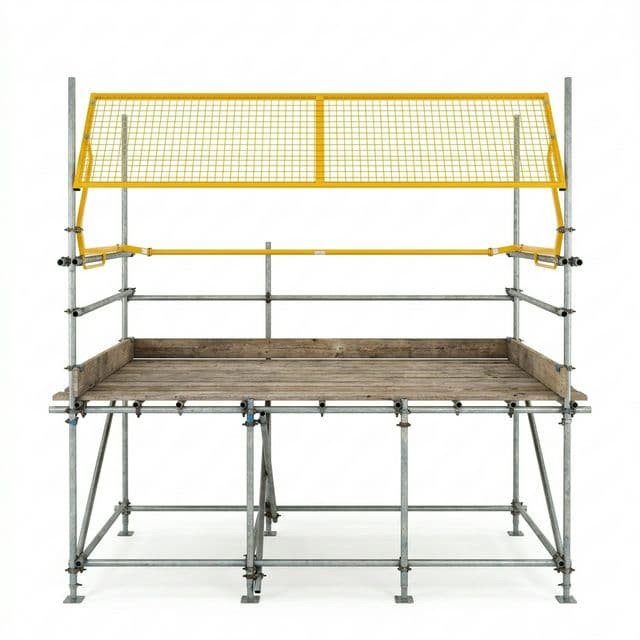
| Guardrail geometry | Top edge 38-45 in (about 965-1143 mm) and maximum 19 in (483 mm) opening between top rail and intermediate member. | Top-rail and gap dimensions must be checked before “ready to order” status. | Different jurisdictions and system details may impose tighter project rules. | OSHA 29 CFR 1926.451 1926.451(g)(4)(ii), 1926.451(g)(4)(v) · accessed 2026-04-28 |
| Toe-board minimum geometry and strength | Toe boards must be at least 3.5 in (9 cm) high and withstand at least a 50 lb (222 N) force. | “Toe board yes/no” is not enough; RFQ should include toe-board dimension and retention detail. | Where stacked materials are higher than toe-board height, paneling or screening may still be required. | OSHA 29 CFR 1926.451 1926.451(h)(2)(ii), 1926.451(h)(4)(ii) · accessed 2026-04-28 |
| Inspection cadence | Scaffold must be inspected by a competent person before each work shift and after events affecting integrity. | Weekly-only or ad-hoc inspections weaken confidence and should push decisions into review/boundary lane. | Inspection records can still fail if findings are not closed before use. | OSHA 29 CFR 1926.451 1926.451(f)(3) · accessed 2026-04-28 |
| Height-to-base stability trigger | Supported scaffolds above a 4:1 height-to-base ratio must be restrained from tipping, with tie/guy spacing limits defined by width and height. | If restraint layout is unknown, procurement should remain in review/boundary lane even when other inputs look “ready.” | A nominal 4:1 check does not replace project-specific temporary works engineering. | OSHA 29 CFR 1926.451 1926.451(c)(1)(ii) · accessed 2026-04-28 |
| Storm/high-wind work and wind-screen control | Work on scaffolds is prohibited during storms/high winds unless a competent person determines it is safe, and wind screens require securing against anticipated wind forces. | Projects using debris netting or sheeting should request wind-basis evidence before release. | This rule sets a stop/go condition, but does not provide project-specific wind-load calculations. | OSHA 29 CFR 1926.451 1926.451(f)(12), 1926.451(c)(1)(ix) · accessed 2026-04-28 |
| Mixed-manufacturer component compatibility | Scaffold components from different manufacturers must not be intermixed unless they fit without force and maintain structural integrity. | Mixed-brand gate substitution should be blocked unless compatibility evidence is documented. | Equivalent-looking dimensions are insufficient evidence without fit and integrity confirmation. | OSHA 29 CFR 1926.451 1926.451(b)(10) · accessed 2026-04-28 |
| Public duty classes for scaffold working platforms | Inspection/light 0.75 kN/m2, general purpose 2.00 kN/m2, heavy duty 3.00 kN/m2 in cited HSE guidance. | Pallet and bay-loading assumptions should be aligned to duty class before gate type decisions. | Duty class alone does not validate complex loading bay configuration design. | HSE HSG150 (Health and safety in construction) Section 6, design loading values · 2015 publication, accessed 2026-04-28 |
| UK statutory inspection interval and record retention | Construction working platforms above 2 m require inspection before first use, then at intervals not exceeding 7 days, with written reports kept on site and retained for 3 months after completion. | When a buyer follows UK legal practice, missing 7-day reports should force review/boundary status. | Legal minimum reporting does not prove technical adequacy of a specific gate design. | Work at Height Regulations 2005 Regulation 12(3), 12(7), 12(8) · accessed 2026-04-28 |
| UK guardrail and gap baseline | Top guardrail at least 950 mm high and unprotected gap no greater than 470 mm. | Cross-border projects should map the stricter dimension where US and UK baselines differ. | HSE guidance is a practical baseline; project method statements may require additional controls. | HSE scaffolding safety topics Scaffolding dimensions and guardrail guidance · accessed 2026-04-28 |
| Standard configuration vs bespoke scaffold design | If scaffold layout is outside recognized standard configurations, it should be specifically designed by competent parties. | Non-standard bay geometry should escalate to design review before procurement release. | Standard-configuration references do not guarantee safe execution quality on site. | HSE scaffolding safety topics General principles for scaffold design and standards · accessed 2026-04-28 |
| Extendable-gate failure warning | HSE safety alert reports incidents where extendable loading-bay gates moved unexpectedly, including unsafe securing with cable ties. | Extendable gate options need explicit locking verification and misuse controls before approval. | Alert highlights failure cases; it is not a universal ban on extendable products. | HSE safety bulletin Loading bay gate safety alert · 2015 alert, accessed 2026-04-28 |
| Source | Supports | Scope and limit | Date marker |
|---|---|---|---|
| OSHA 29 CFR 1926.451 | Load floor (4x intended load), guardrail/tie/wind thresholds, mixed-component compatibility, toe-board criteria, inspection cadence. | US baseline regulation; project-specific engineering details are still required. | accessed 2026-04-28 |
| HSE scaffolding safety topics | UK practical baselines for guardrail dimensions, gap control, inspections, and standard-vs-bespoke design trigger. | UK regulator guidance page; does not replace project method statement. | accessed 2026-04-28 |
| HSE HSG150 | Public loading-class baselines used in calculator duty lanes. | General construction safety guidance; detailed design must follow competent engineering workflow. | 2015 edition, accessed 2026-04-28 |
| HSE loading bay gate safety bulletin | Risk warning for extendable gate misuse and insecure temporary restraints. | Incident warning signal, not a complete technical design framework. | 2015 bulletin, accessed 2026-04-28 |
| Work at Height Regulations 2005 (UK law) | Statutory inspection timing and record-retention requirements for construction working platforms. | Legal baseline for UK projects; does not by itself determine technical design adequacy. | accessed 2026-04-28 |
| BLS CFOI 2024 release | Recent US fatal-injury signal: 5,283 total fatalities in 2024 and 844 falls/slips/trips. | Macro risk context only; does not isolate loading-bay gate failure rates. | published 2025-12-16, accessed 2026-04-28 |
| HSE work-related fatal injuries overview | Recent GB context: 124 worker fatalities in 2024/25, including 35 falls from a height. | National trend context; not specific to scaffold loading-bay gate subtype decisions. | updated 2025-07-30, accessed 2026-04-28 |
| Repo keyword exports and alias checklist | Canonical keyword volume, CPC, and alias-cluster mapping integrity. | Internal SEO operations data; not a substitute for on-site safety evidence. | exports dated 2026-03-24 |
| Stage1b gap | Applied fix |
|---|---|
| Initial draft covered tool logic but lacked explicit regulator citations near output interpretation. | Added clause-level OSHA and HSE references in regulatory matrix and evidence ledger. |
| Alias intent was mentioned but not converted into a dedicated canonical anchor answer. | Added adjustable-loading-bay-gates anchor section and canonical internal links. |
| Risk section listed generic warnings without source-backed extendable-gate failure context. | Added HSE safety-bulletin evidence and extendable-gate misuse risk control actions. |
| Comparison block lacked tradeoff framing tied to action outcomes. | Expanded comparison matrix with speed/flexibility/risk/watchout plus next-step guidance. |
| Boundary and unknown scope was not explicit enough for procurement decision gatekeeping. | Added known-vs-unknown ledger and boundary-focused scenario examples. |
| Restraint triggers for high height-to-base scaffolds were mentioned in risk prose but not tied to explicit legal thresholds. | Added OSHA 4:1 stability clause and tie/guy implications to the regulatory matrix plus scenario/risk rows. |
| Wind and sheeting checks in the tool lacked adjacent clause-level evidence for stop-work conditions. | Added OSHA storm/high-wind and wind-screen securing clauses, then linked them to procurement consequences. |
| UK inspection practice was present as guidance but lacked explicit statutory report-retention requirements. | Added Work at Height Regulations references for 7-day interval and record retention windows. |
| Risk urgency lacked current public injury context and did not clearly flag unavailable gate-style failure-rate denominators. | Added BLS/HSE recent fatality indicators and explicit “no reliable public dataset currently available” boundaries. |
| Option | Speed | Flexibility | Risk profile | Best for | Watchout |
|---|---|---|---|---|---|
| Fixed hinge gate set | Fast in repetitive bay geometry | Low-medium (width fixed by panel set) | Lower moving-part complexity | Stable bay width and repeat logistics pattern | Can fail fit checks when bay width varies between towers or projects. |
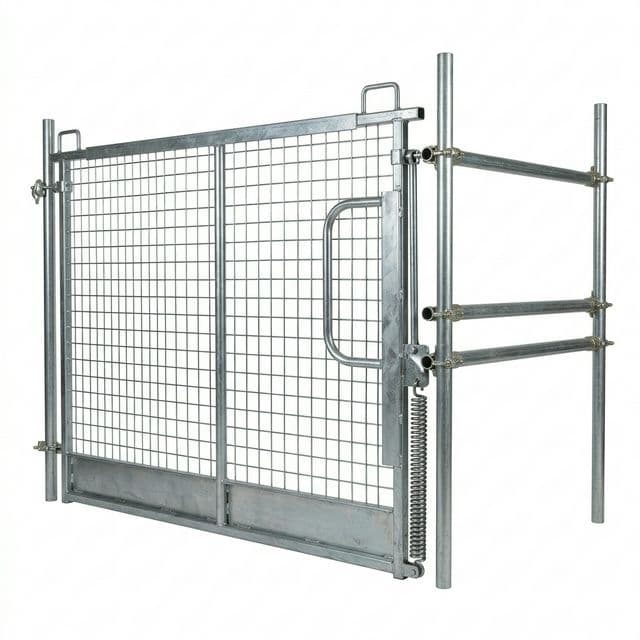
| Adjustable sliding gate set | Medium setup speed | High for mixed bay widths | Moderate; lock discipline is critical | Teams serving variable bay widths in one batch | Misadjusted locks or poor handover records can create hidden gap risk. |
| Up-and-over gate set | Fast handling where vertical clearance is available | Medium | Medium-high if lifting path is congested | Lift-intensive bays with disciplined movement controls | Requires clear movement envelope and anti-drop controls in operations. |
| Extendable gate set | Fast for temporary width change | High | Higher misuse risk when secured incorrectly | Variable geometry with strict procedural enforcement | Public HSE alert indicates elevated risk if makeshift restraints are used. |
| Risk | Probability | Impact | Mitigation |
|---|---|---|---|
| Top rail outside accepted range or missing intermediate protection | Medium | High | Stop release, correct geometry, and document re-inspection before use. |
| Ad-hoc inspection cadence with no competent-person signoff | Medium | High | Shift to each-shift inspection log and enforce closeout actions. |
| Extendable gate secured with temporary restraints | Low | High | Ban temporary restraints and verify manufacturer locking procedure onsite. |
| Duty class mismatch versus actual pallet loading | Medium | High | Recalculate against 0.75/2.00/3.00 kN/m2 duty lanes before procurement approval. |
| No explicit tie/restraint plan at high height-to-base ratio | Medium | High | Apply 4:1 trigger screening and attach tie/guy/bracing layout evidence before release. |
| Work continues during high winds or with unsecured wind screens | Low | High | Pause work unless competent-person clearance and wind-control evidence are documented. |
| Mixed-manufacturer gate/scaffold components forced into fit | Medium | High | Block mixed-brand substitution until fit-without-force and structural-integrity evidence is provided. |
| Alias route split creates duplicated and conflicting guidance | Low | Medium | Keep one canonical URL and route aliases through anchor-based intent answers. |
| Item | Known | Unknown | Decision impact |
|---|---|---|---|
| Public guardrail and fall-protection thresholds | OSHA/HSE public thresholds provide baseline for tool gating and boundary labels. | Project-specific engineering verification and local authority overlays are not public in one dataset. | Tool can pre-screen, but final release may require project engineer confirmation. |
| Duty-class numbers for initial loading lane selection | Public HSE values provide transparent starting point (0.75/2.00/3.00 kN/m2). | Supplier-specific test curves for exact loading bay gate configuration are not uniformly public. | High-load or mixed-load projects should request supplier-certified pack before PO. |
| Extendable-gate misuse risk signal | HSE bulletin documents incident pattern where insecure restraint caused hazardous movement. | No reliable public incident-rate denominator by gate subtype is currently available. | Treat extendable setups as stricter review lane when process controls are unclear. |
| Alias demand cluster scope | Alias checklist confirms adjustable loading bay gates belongs to same canonical intent cluster. | Query-by-query conversion behavior for each alias is not directly observable in this repository. | Preserve one URL while adding explicit anchor answers for high-signal aliases. |
| Inspection discipline evidence quality | Before-shift and periodic checks are explicitly required in public rules. | Actual site compliance quality varies and cannot be inferred from procurement forms alone. | Tool should downgrade to review/boundary when records are missing or ad-hoc. |
| Cross-system interchangeability | Compatibility cannot be assumed across manufacturers without matching technical details. | Universal interchangeability matrix is not available in open public sources. | Force evidence request for mixed-brand substitutions before release. |
| Cross-jurisdiction geometry baselines | US baseline cites 38-45 in top-rail and 19 in openings; UK guidance cites 950 mm top guardrail and 470 mm max gap. | No single public mapping table tells which project-level contract requirement prevails when these baselines differ. | Cross-border RFQs should declare governing standard and use the stricter control until clarified. |
| Outcome data for gate-style safety performance | Official fatal-injury series show falls remain a material construction risk signal. | No reliable public dataset currently isolates failure rates by loading-bay gate style. | Use qualitative risk controls plus documented inspections instead of claiming precise gate-style risk rankings. |
| Scenario | Assumptions | Tool outcome | Next action |
|---|---|---|---|
| Facade tower with 2.8 m bay width and general-purpose loading lane | Top rail 1000 mm, toe board present, each-shift inspection, fixed hinge gate. | Ready lane with normal RFQ checklist | Proceed to supplier inquiry with load class and inspection cadence attached. |
| Mixed-width project using adjustable loading bay gates | Bay widths from 2.2 m to 3.1 m, adjustable sliding gate, weekly plus shift checks. | Review lane due geometry variation complexity | Request lock-setting SOP and sample inspection records before PO release. |
| High-wind perimeter with debris netting and extendable gates | Netted bay, uncertain design basis, ad-hoc inspection only. | Boundary lane | Stop procurement path until design basis and lock controls are verified. |
| Tall tower where height-to-base ratio exceeds 4:1 | General lane loads, acceptable rail geometry, but tie/guy layout record is missing. | Review to boundary lane depending on evidence quality | Do not release PO until restraint layout and competent-person signoff are attached. |
| Alias intent: “adjustable loading bay gates” inquiry | Buyer needs width flexibility, same risk controls as canonical query. | Same calculator and report path on canonical URL | Use anchor #adjustable-loading-bay-gates-answer and continue same tool workflow. |
Use when gate results need supplier test and inspection evidence closure.
Use after lane decision when freight density and pack logic become the next gate.
Use when loading bay gates must be bundled with other scaffold accessories in one RFQ.
Use when load path questions spill from gate selection into support-system capacity checks.
Use when support-hardware decisions overlap with loading-bay access planning.
Send your result with geometry, duty, inspection cadence, and gate-lane assumptions to keep vendor communication aligned with the same evidence chain used on this page.
Commercial support
Share your lane result and we will reply with a model recommendation, assumption checklist, and boundary notes in one thread.
This page provides planning and procurement decision support. It does not replace site-specific engineering design, temporary works approval, or competent-person inspections.
Data includes public regulator documents and internal keyword exports with explicit date markers. Unknowns remain visible where open evidence is limited.